
What Is SEO Marketing in 2026?
The Ultimate Guide for Canadian Businesses
Download the Free CAUSE SEO Marketing 7-Step Checklist for quick and easy wins.
Written by Leah Carter
Leah Carter is the founder of CAUSE Marketing Agency and the creator of the CAUSE SEO Marketing System. She helps Canadian businesses and nonprofits grow with SEO Marketing that drives results—not just traffic.
Connect with Leah on LinkedIn
What This Guide Covers
SEO marketing has evolved.
In 2026, SEO marketing is no longer just about rankings, keywords, and technical fixes. For Canadian businesses and nonprofits, visibility now depends on content quality, website performance, local SEO, trust signals, user experience, and how well your organization shows up across search and AI-driven platforms.
This guide explains SEO marketing in clear, practical language. It will help you understand what SEO marketing is today, why it feels so confusing, why it matters in Canada, how AI is changing search, and how to build a more connected strategy for visibility, credibility, and results.
Inside this guide, we cover:
- What SEO Marketing is in 2026
- SEO vs SEO Marketing
- Why SEO Marketing feels so confusing
- Why SEO Marketing matters in Canada
- How AI is changing search
- The 7-stage SEO Marketing framework
- The SEO metrics and KPIs to track
- What to do next
What Is SEO Marketing in 2026?
SEO marketing in 2026 is no longer just about ranking on Google—it is about building a complete visibility, trust, and conversion system.
In the past, SEO focused primarily on keywords, backlinks, and technical optimization to improve search rankings. While these elements still matter, they are now only part of a much larger ecosystem. Today, SEO marketing includes how your organization shows up across search engines, AI-driven platforms, local listings, social channels, and other digital touchpoints where people look for information and make decisions.
At its core, SEO marketing is how your business or nonprofit gets discovered, builds credibility, and turns attention into action.
This includes:
- Search visibility across Google, AI search tools, and local platforms
- Content marketing that answers real questions and demonstrates expertise
- Technical SEO that ensures your website is fast, accessible, and easy to understand
- Local SEO that helps you show up in your community and region
- Trust signals such as reviews, testimonials, and consistent brand presence
- User experience that makes it easy for people to navigate, understand, and take action
In 2026, search engines and AI systems do not just rank content—they evaluate credibility, relevance, and usefulness. That means SEO marketing is no longer about “getting clicks” alone. It is about creating a digital presence that earns trust and drives meaningful outcomes.
CAUSE Definition of SEO Marketing (2026)
At CAUSE, we define SEO marketing as a type of digital marketing that builds a full-funnel system—clarifying your positioning, attracting qualified visibility, converting interest into action, and retaining relationships for sustainable growth across search and AI platforms.
A simple way to understand SEO marketing today is: Get found → Build trust → Drive action → Grow relationships
When these elements work together, SEO marketing becomes one of the most powerful and sustainable ways to generate leads, bookings, donors, inquiries, and revenue.
SEO vs. SEO Marketing
Traditional SEO
Built to improve rankings and traffic
Traditional SEO focuses on helping your website rank higher in search engines. It usually emphasizes keywords, on-page optimization, backlinks, and technical SEO to increase visibility and drive traffic.
It is important—but it is often more focused on attracting clicks than converting them.
SEO Marketing
Built to turn visibility into outcomes
SEO Marketing includes SEO, but goes further. It focuses on the full journey—from discovery to trust to action to retention.
Instead of stopping at rankings, SEO Marketing helps ensure your digital presence is clear, credible, and designed to generate meaningful results such as leads, bookings, donor interest, inquiries, and long-term growth.

Why SEO Marketing Feels So Confusing
SEO marketing feels confusing today because the rules have changed—but most explanations have not.
For years, SEO was described as a way to rank higher on Google using keywords, backlinks, and technical optimization. While those elements still matter, they are now only part of how search works in 2026.
Today, search visibility is influenced by a combination of factors, including AI-generated results, content quality, user experience, local SEO, trust signals, and how effectively your digital presence turns attention into action.
This shift has created a gap between what organizations are doing and the results they expect.
Many Canadian businesses and nonprofits are experiencing:
- website traffic without inquiries or conversions
- content creation without improved visibility
- SEO investments without clear ROI
- multiple marketing tools and platforms without a unified strategy
The confusion comes from trying to apply an outdated SEO approach to a modern, more complex system.
Search engines and AI platforms now prioritize credibility, relevance, and consistency across your entire digital presence—not just individual pages or keywords. This means your website, content, local listings, reviews, and user experience all work together to influence how and whether you are discovered.
A simple way to understand why SEO marketing feels confusing is this:
The old model focused on ranking pages.
The new model focuses on building trust and driving action.
If your strategy is still focused only on rankings, you may see visibility without results—or effort without growth.
The good news is that once you shift your approach and understand SEO marketing as a connected system, it becomes much clearer—and much more effective.
Why SEO Marketing Matters in Canada
SEO marketing matters in Canada because the way businesses and decision-makers research and evaluate options has changed.
Today, most buying journeys involve online research. People use search engines, websites, reviews, and digital content to compare providers, assess credibility, and decide who they trust—especially for services, B2B relationships, and nonprofit partnerships.
This shift is reflected in broader marketing data. According to HubSpot’s State of Marketing Report, AI is fundamentally changing how businesses find and engage customers, and updating SEO strategies for modern search is now a top priority for organizations.
That matters because Canadian buyers are more informed, more selective, and more independent than ever. They often complete a significant portion of their research before ever contacting a business.
In 2026, SEO marketing helps organizations improve search visibility, build trust earlier in the decision-making process, reduce reliance on paid advertising, and develop the long-term authority needed to compete locally and nationally.
How AI Is Changing SEO Marketing in 2026
AI is not replacing SEO marketing—it is raising the standard.
In 2026, AI-driven search is changing how people discover, compare, and trust organizations online. Search engines and AI systems are getting better at identifying content that is helpful, reliable, specific, and created for people—not content produced just to rank. Google explicitly advises site owners to focus on helpful, reliable, people-first content and to use E-E-A-T as a way to evaluate quality.
For Canadian businesses and nonprofits, that matters. Buyers, partners, and donors often research carefully, compare options, and look for proof before taking action. In that environment, generic content is easier to ignore, while credible content is more likely to earn visibility and trust.
What E-E-A-T Means for SEO Marketing
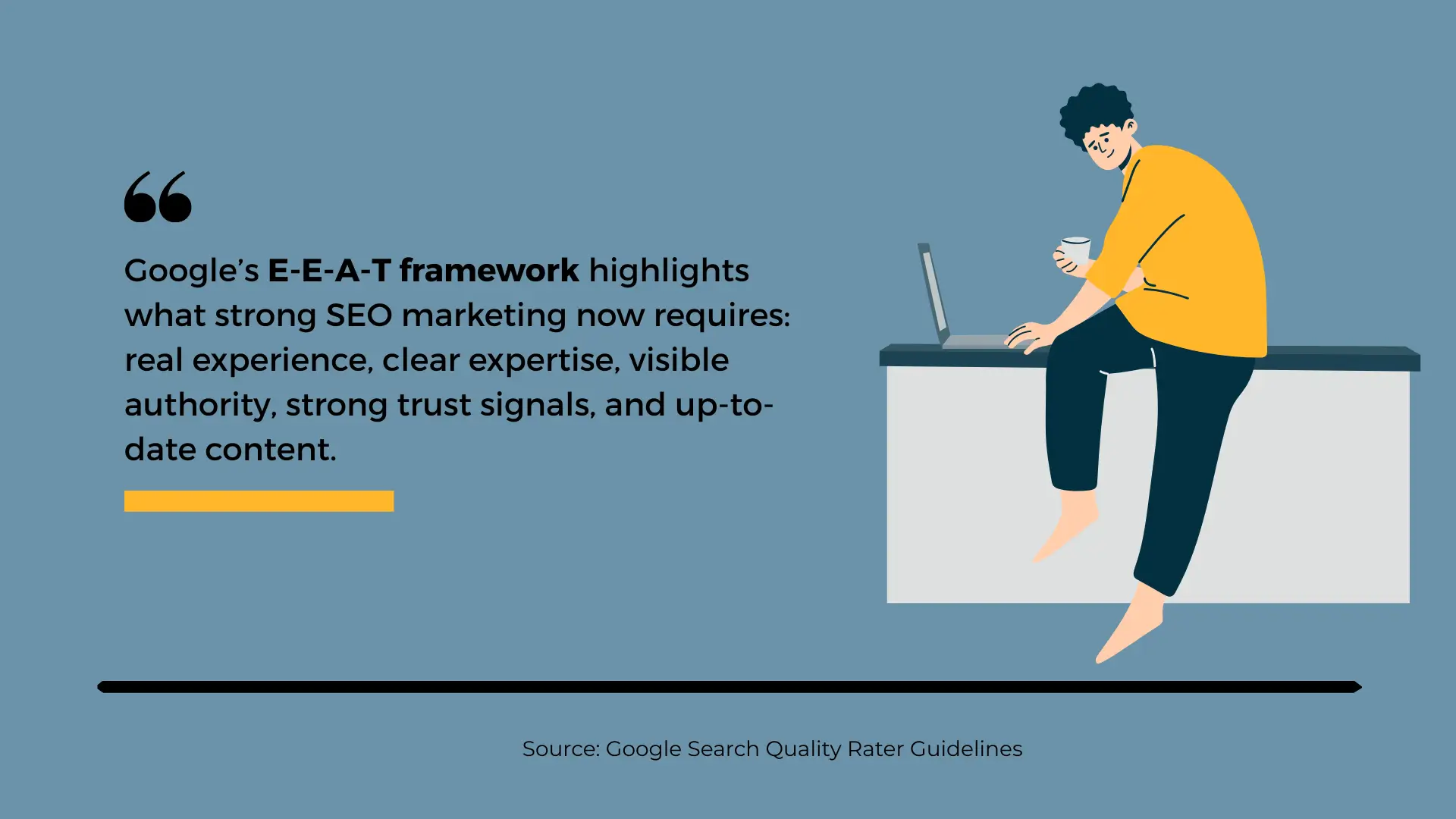
Google’s Search Quality Rater Guidelines emphasize the importance of Experience, Expertise, Authoritativeness, and Trust (E-E-A-T), with trust being the most critical factor.In practical terms, your online presence should demonstrate:
- Experience — real examples, firsthand insights, case studies, and clear evidence that you have done the work
- Expertise — accurate, useful content created by people who understand the topic
- Authoritativeness — a strong reputation, quality mentions, relevant backlinks, and visible credentials
- Trust — reviews, clear policies, secure browsing, transparent contact information, and consistent brand details
- Freshness — updated content that reflects current information, services, and search behavior
If your content is clear, useful, and credible, you improve your chances of being surfaced across search and AI-driven experiences. If it is generic, outdated, or thin, it becomes much easier to overlook. Google’s public guidance also stresses page experience, helpful content, and content that is easy for its systems to understand.
The organizations that win in 2026 are not the ones publishing the most content. They are the ones building real authority—and proving it consistently across their website, content, reputation, and digital presence.
What Are the 7 Stages of SEO Marketing?
SEO Marketing works as a connected system—not a single tactic. When each stage is aligned, visibility turns into trust, and trust turns into measurable growth.
The CAUSE SEO Marketing System follows a simple, repeatable path:
Clarify → Attract → Capture → Nurture → Convert → Retain → Sustain
Below is a practical breakdown of how each stage works.

1. Clarify — Get Clear Before You Optimize
Before keywords, content, or SEO tools, you need clarity.
Clarity defines:
- who you serve
- what problem you solve
- what outcome you deliver
- what makes you different
Without this, your messaging becomes scattered—and scattered messaging doesn’t rank or convert.
2. Attract — Show Up Where Your Audience Is Searching
Attraction is about visibility across:
- Google search
- AI-driven search
- local SEO (maps, directories)
- social platforms
Your website acts as your authority hub, while your content answers real questions and builds credibility.
The goal is not more traffic—it’squalified traffic.
3. Capture — Turn Visitors into Contacts
Traffic alone is not growth.
Capture means turning interest into action while it’s still warm.
This includes:
- clear calls-to-action
- lead magnets or resources
- booking systems
- contact forms
If the next step isn’t obvious, people leave—even if they trust you.
4. Nurture — Build Trust Over Time
Most decisions don’t happen immediately—especially in Canada, where research and internal alignment matter.
Nurturing builds trust through:
- education
- consistent communication
- proof (case studies, results, testimonials)
In 2026, trust doesn’t just improve conversions—it also improves visibility in AI-driven search.
5. Convert — Make It Easy to Take Action
Conversion is where SEO Marketing becomes measurable results.
To convert effectively, your site needs:
- clear messaging
- strong proof
- simple next steps
This might include:
- service pages
- landing pages
- testimonials
- booking tools
Without clarity, even the right traffic won’t convert.
6. Retain — The Growth Multiplier
Retention drives long-term growth.
It leads to:
- repeat customers or donors
- referrals
- higher lifetime value
- stronger brand authority
It also supports SEO Marketing through:
- returning visitors
- ongoing engagement
- consistent trust signals
7. Sustain — Measure and Improve
SEO Marketing is not static—it evolves.
Sustain means:
- tracking performance
- measuring outcomes (not just traffic)
- refining what works
Momentum builds over time—and compounds when the system is working.
What SEO Metrics and KPIs to Track
SEO marketing is not just about traffic—it is about outcomes.
To understand if your SEO marketing system is working, focus on the metrics that reflect visibility, trust, and conversion—not just clicks.
Track:
- Organic visibility — your presence in search results (SEO and AIO), including impressions and rankings
- Qualified traffic — the right people visiting your website, not just volume
- Conversions — inquiries, bookings, downloads, donations, or calls
- Conversion rate — how effectively your traffic turns into action
- Local SEO performance — Google Business views, calls, direction requests, and reviews
- Pipeline or revenue impact — leads, opportunities, and sales influenced by SEO marketing
If your SEO is working, you should see not just more traffic—but better outcomes.
Get the Free CAUSE SEO Marketing 7-Step Quick Wins Checklist
Ready to strengthen your visibility, trust, and conversions?
Download the free CAUSE SEO Marketing 7-Step Quick Wins Checklist for a practical walkthrough of the 7 steps in the CAUSE SEO Marketing System.
It is designed to help you quickly identify gaps, uncover opportunities, and take action across each stage of your SEO marketing strategy.
Inside, you will get quick wins for how to:
- Clarify your positioning and messaging
- Attract the right audience through search and AI visibility
- Capture interest with stronger calls to action
- Nurture trust with helpful, credible content
- Convert more visitors into inquiries, bookings, or donors
- Retain relationships and strengthen long-term value
- Sustain results by tracking what is working and improving over time

A Final Note from Leah Carter
If you are a business owner or nonprofit leader reading this, I want to leave you with this:
SEO marketing does not have to feel overwhelming. But in 2026, it does need to be more connected, more intentional, and more focused on trust than ever before.
Your audience is already searching, comparing, and deciding who feels credible enough to contact. The question is whether your digital presence is helping them find you—and feel confident taking the next step.
That is why I created the CAUSE SEO Marketing System: to help organizations build visibility, trust, and real results in a way that is strategic, practical, and sustainable.
If you are ready to strengthen your SEO marketing, download the CAUSE SEO Marketing 7-Step Quick Wins Checklist and get your free SEO audit to see where your website and digital presence may be missing opportunities.
Start building a stronger SEO marketing system today.
— Leah Carter
CEO, CAUSE Marketing