
Updated October 2026 · CAUSE Marketing Agency
The way people search for businesses is changing, and it’s happening fast.
Instead of just typing a few keywords into Google and clicking through a list of websites, customers can now describe exactly what they need, ask follow-up questions, compare options, and let AI do a lot of the research and decision-making legwork for them.
And this isn’t a small shift.
In May 2026, Google reported that AI Mode had surpassed one billion monthly active users globally, with AI Mode queries more than doubling every quarter since launch. Google also reported that the average AI Mode query is three times longer than a traditional Google Search query.
Here’s why that matters for your business: longer, more conversational searches carry a lot more information about what a customer actually wants.
Someone might once have searched:
“accountant Vancouver”
Today, they can ask:
“I own a growing construction company in Vancouver. What type of accountant should I look for to help with bookkeeping, corporate tax and managing cash flow as we hire more employees?”
That single question contains:
- A customer type
- An industry
- A location
- A business stage
- Multiple services
- A specific business problem
- A desired outcome
This is the shift you need to wrap your head around.
Your website doesn’t just need to mention what you sell. It needs to give AI systems enough clear, useful information to understand exactly where your business fits within these much more specific customer questions.
Key Takeaways
- AI search is growing fast: Google’s AI Mode passed one billion monthly users in 2026, with queries doubling every quarter and running three times longer than typical searches.
- Longer, conversational questions pack in a customer’s type, industry, location, problem and desired outcome, so your business needs to be understandable within that full context, not just tied to a keyword.
- Google’s query fan-out technique breaks a complex question into related subtopics, meaning one page targeting one keyword isn’t enough to show everything your business knows and does.
- AI systems pull from more than your website, so keeping your Google Business Profile, directories, reviews and other mentions consistent helps AI build an accurate picture of your business.
- Useful, well-structured content (service pages, FAQs, guides, comparisons, case studies, images and video) builds the topical depth AI needs to understand and recommend your business.
- Google’s Search Console now reports on AI visibility, so businesses can measure impressions and performance in AI Overviews and AI Mode instead of guessing.
- A CAUSE AI Visibility Audit tests real customer questions against your business to find gaps in clarity, content and authority, then turns them into a prioritized action plan.
What Is AI Search?
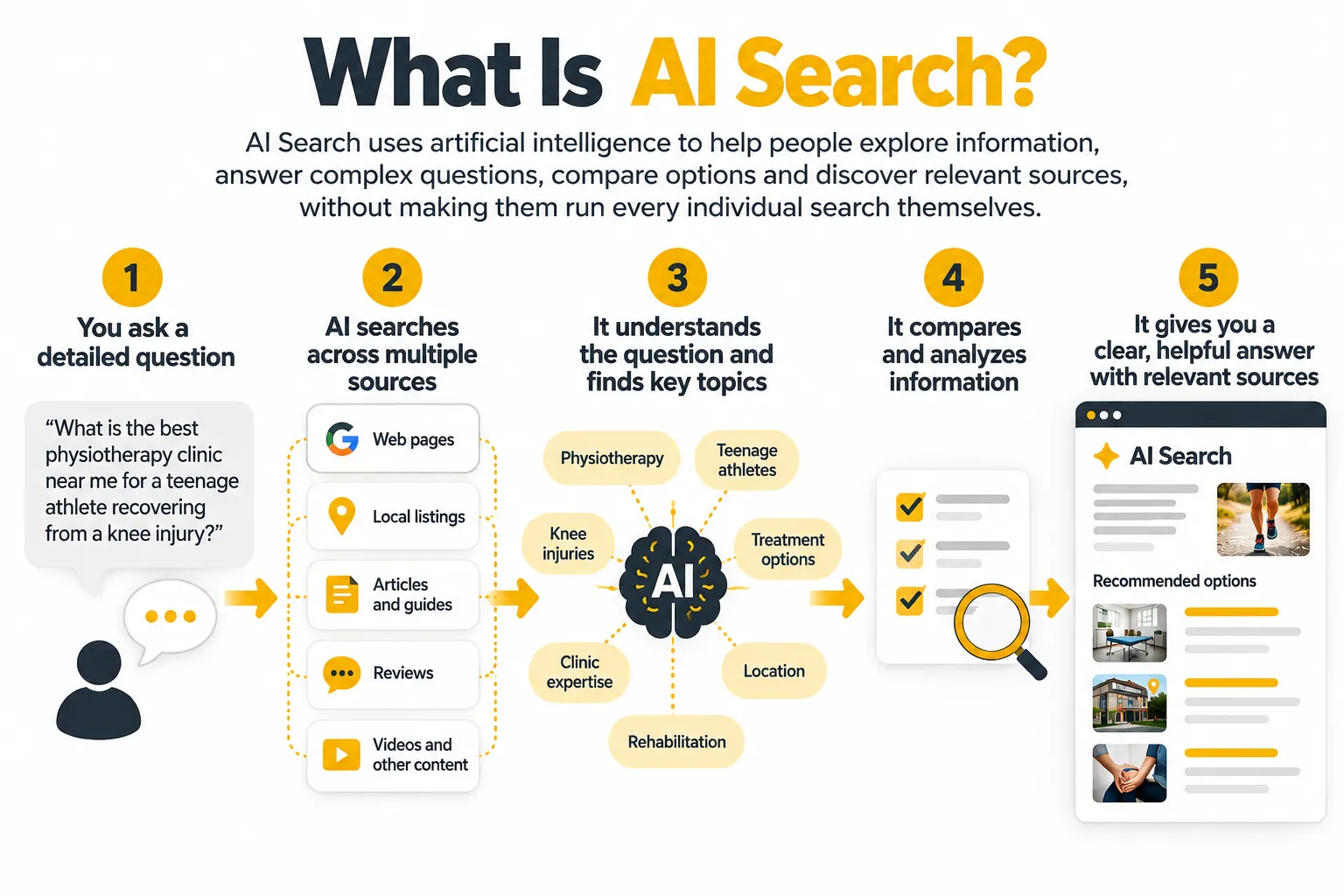
AI Search uses artificial intelligence to help people explore information, answer complex questions, compare options and discover relevant sources, without making them run every individual search themselves.
Google describes AI Mode as especially useful for complex, multi-part questions and follow-ups, including things like comparing products, planning, and working through complicated how-to questions.
In fact, when Google introduced AI Mode in Canada, it reported that early users were already asking questions two to three times the length of traditional search queries.
For businesses, that changes how customers find you in the first place.
A potential customer may not simply search for the name of your service.
Instead, they may ask AI to help them figure out:
- What type of service they need
- Which solution fits their problem
- What they should look for in a provider
- What options are available locally
- How different options compare
- Which businesses specialize in their particular need
- What they should consider before buying
- Which provider might be right for their situation
That means your business needs to be understandable within the context of the customer’s problem, not just tied to a keyword.
People Are Searching Differently With AI
Google’s own 2026 data gives businesses a real look at how AI is changing search behaviour.
Google reported several major changes in how people are using AI Mode:
- AI Mode had surpassed one billion monthly active users globally
- AI Mode queries had more than doubled every quarter since launch
- The average AI Mode search was three times the length of a traditional Search query
- More than one in six searches in the U.S. used voice or images
- Image searches were growing more than 40% month over month
- AI Mode queries related to planning had grown 80% faster than AI Mode queries overall during the previous six months
- Brainstorming queries had grown 30% faster than AI Mode queries overall since launch
- Searches beginning with phrases such as “where to,” “where should I,” and “ideas for” were growing
Why does this matter to you? Because your customers can now give AI far more context about what they actually need.
They can search by:
- Problem
- Service
- Location
- Industry
- Customer type
- Specialization
- Desired outcome
- Budget
- Timing
- Features
- Preferences
- Comparisons
- Questions
- Images
- Voice
That’s an opportunity for businesses that have built enough clear, useful information around the things their customers genuinely care about.
How Does Google AI Search Find Information?
One of the most important concepts for you to understand is query fan-out.
So instead of treating a complex customer question as one single search, Google can explore several related parts of that question at once.
Suppose someone asks:
“What should I look for in a physiotherapy clinic for a teenage athlete recovering from a knee injury?”
That question touches on several topics that could matter:
- Physiotherapy
- Sports physiotherapy
- Teenage athletes
- Knee injuries
- Rehabilitation
- Return-to-sport programs
- Practitioner expertise
- Treatment approaches
- Location
- Clinic information
Google says its AI systems can identify additional supporting webpages while generating a response.
According to Google, this lets AI Mode and AI Overviews surface a wider and more diverse set of helpful links than a classic web search would.
Here’s what that means for your content:
One page targeting one keyword isn’t enough to explain everything your business knows, does and specializes in.
Your digital presence needs enough useful information to establish the different topics, services, problems, locations and areas of expertise tied to your business.
What Does AI Need to Understand About Your Business?
Before an AI system can accurately describe your business, it needs clear information to work with.
That includes:
- Who you are
- What your business does
- What services you provide
- Who those services are for
- What problems you solve
- Where you provide those services
- What industries or customers you specialize in
- What expertise or credentials back up your claims
- What makes your services different
- What customers say about your business
- How your business is represented elsewhere online
This is where a lot of business websites run into trouble.
A website can look beautiful while telling AI (and visitors) almost nothing useful about the company behind it.
Headlines like:
“Solutions designed for you.”
“Experience the difference.”
“Taking your business to the next level.”
might sound good, but on their own they don’t actually say what the business does.
Now compare that with:
Commercial Cleaning for Medical and Dental Clinics in Vancouver
Right away, there’s real context:
- Service: Commercial cleaning
- Specialization: Medical and dental facilities
- Location: Vancouver
- Customer: Healthcare businesses
The goal isn’t to make your website copy sound robotic.
The goal is to clear out unnecessary ambiguity.
AI Search Is Creating More Complex Discovery Journeys
AI Search makes it more important than ever to think about the whole subject surrounding a customer’s need, not just the primary service they might search for.
Take someone researching estate planning.
Their questions might touch on:
- Wills
- Powers of attorney
- Executors
- Probate
- Estate taxes
- Business ownership
- Real estate
- Beneficiaries
- Blended families
- Fees
- Timelines
- Local laws
Because Google’s query fan-out technique can search across multiple related subtopics and data sources, you have an opportunity to be discovered through deeper, more specific parts of a customer’s research journey.
So a business needs more than a homepage that says:
“We provide estate planning.”
It needs a genuinely useful body of information that shows what it actually knows about the subject.
Build Topical Depth Around What Your Business Knows
This does not mean publishing hundreds of articles just to pump out more content.
In its May 2026 guidance for generative AI Search, Google specifically highlighted the importance of valuable, unique, non-commodity content.
For your business, that kind of useful content can include:
- Service pages explaining individual services in depth
- FAQs answering real customer questions
- Guides helping customers work through complicated decisions
- Comparisons explaining differences between services, products or solutions
- Case studies showing real experience and outcomes
- Articles addressing specific customer problems
- Location pages explaining where and how services are provided
- Expert commentary sharing first-hand professional knowledge
- Original research based on your company’s own knowledge or data
- How-to resources showing your expertise in practice
- Checklists helping customers make decisions or take action
- Glossaries explaining industry terminology
- Videos demonstrating expertise or answering questions
- Images and infographics explaining useful information visually
It’s not about more content for the sake of more content.
It’s about building a genuinely useful body of information around the subjects your business actually knows.
Your Website Is Not the Only Source AI Can Use
Your website matters, but your business lives across a much bigger digital ecosystem than just your own site.
Information about your business can also show up through:
- Google Business Profile
- Business directories
- Professional associations
- Industry websites
- Review platforms
- News coverage
- Partner websites
- Local organizations
- Chambers of commerce
- BIAs
- Government directories
- Social profiles
- Interviews
- Podcasts
- Awards
- Certifications
- Expert articles
- Third-party mentions
That’s why consistency matters so much.
If your website says you specialize in one thing, your Google Business Profile says something else, your directory listings are out of date, and other websites describe your business differently, AI gets a blurrier picture of who you actually are.
The goal is to build a consistent digital identity around:
- Your business
- Your services
- Your expertise
- Your locations
- Your people
- Your specializations
AI Search Is Increasingly About Decisions, Not Just Answers
This might be one of the biggest opportunities here for your business.
People aren’t just using AI to look up facts anymore.
They’re using it to plan, compare, explore and make decisions.
Google also reported growth in discovery-oriented searches starting with phrases like:
- “Where to”
- “Where should I”
- “Ideas for”
Here’s why that matters to you: customers can now ask AI things like:
- Where should I go?
- What should I choose?
- Which option fits my needs?
- What should I consider?
- What type of professional do I need?
- What businesses provide this?
- What are my options?
- How do the options compare?
- What should I do next?
These aren’t just casual, informational searches.
A lot of them happen much closer to an actual decision.
What Makes Content Useful for AI Search?
There’s no magic formula that guarantees an AI recommendation, and we won’t pretend otherwise.
Google’s current guidance focuses heavily on the quality and usefulness of the information itself.
For your website, the important pages should clearly communicate:
- What the page is about
- Who the information is for
- What question it answers
- What problem it addresses
- What service it relates to
- Who provides the information
- What expertise supports it
- Where the service is available
- What someone should know before making a decision
- Where the reader can find related information
Useful page structures can include:
- Descriptive headings
- Direct answers
- Short explanatory paragraphs
- Bullet points
- Numbered steps
- Tables
- Comparisons
- FAQs
- Examples
- Original images
- Videos
- Internal links
- Credible external sources
The goal isn’t to write for a machine.
It’s to make your expertise clear enough that both people and machines can understand it.
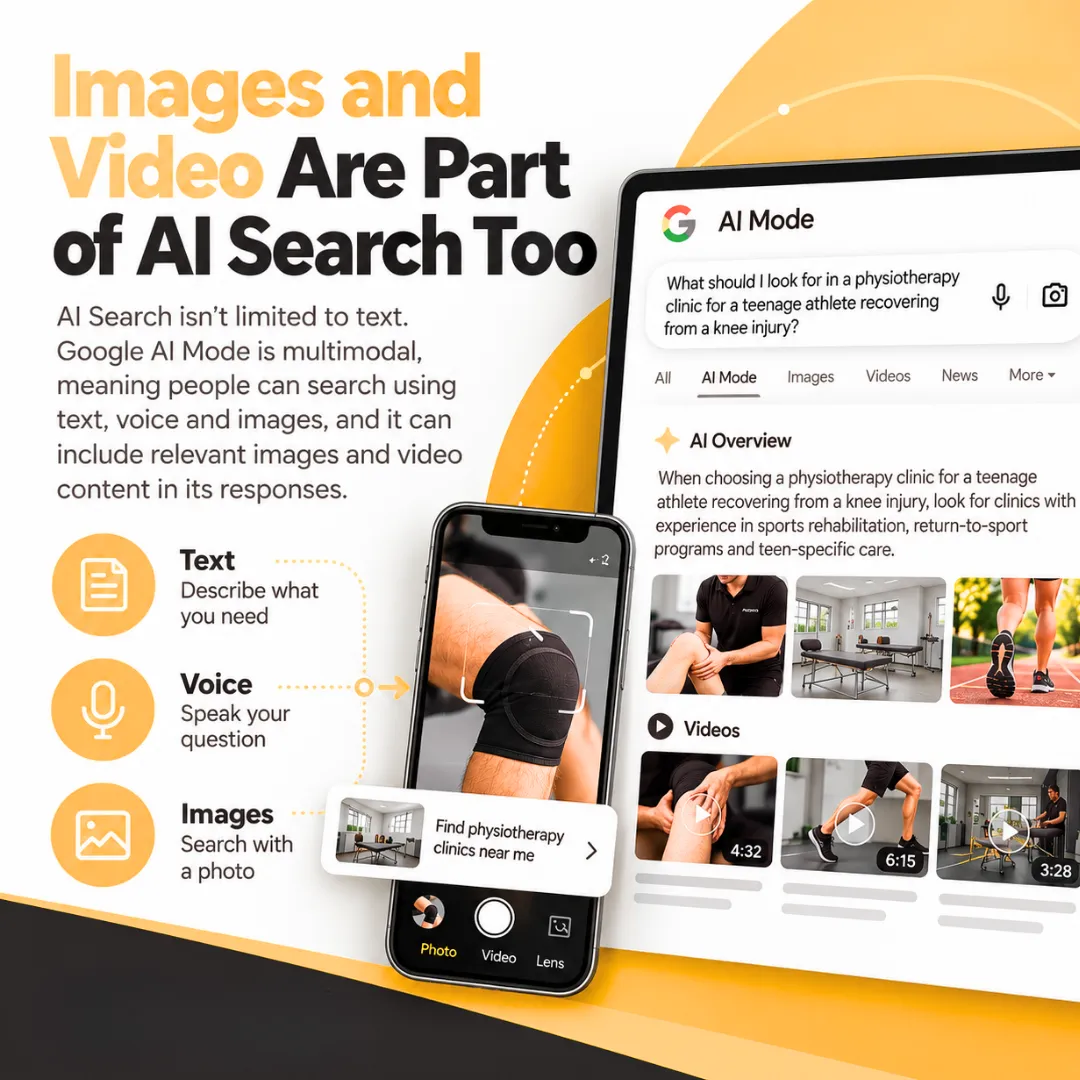
Images and Video Are Part of AI Search Too
AI Search isn’t limited to typed text.
Google AI Mode is multimodal, allowing people to search using text, voice and images.
Google’s May 2026 guidance for generative AI Search also specifically calls out recommendations around local, image and video content.
For your business, useful visual assets can include:
- Original business photography
- Product photography
- Team photographs
- Facility photographs
- Before-and-after examples where appropriate
- Demonstration videos
- Explainer videos
- Educational videos
- Infographics
- Diagrams
- Charts
- Process illustrations
Visual content should also come with context.
That can include:
- Descriptive file names
- Relevant alt text
- Captions where useful
- Supporting text around the image
- Clear connections to the page topic
And this is becoming a lot easier to measure.
On September 24, 2026, Google announced Search Console reporting for web multimodal searches, including searches involving Lens, Circle to Search, image uploads and Chrome’s “Search this image” feature.
Can You Measure AI Search Visibility?
Yes, and this is one of the most exciting developments for businesses in 2026.
On June 3, 2026, Google announced new Search Generative AI performance reports in Search Console.
Google says the reports give you dedicated visibility information for generative AI features including AI Overviews and AI Mode, and as of August 31, 2026, Google had rolled the insights out to websites worldwide.
The reporting includes:
- Impressions: How often URLs from your website appeared in generative AI features
- Pages: Which website URLs appeared
- Countries: Where your AI visibility occurred
- Devices: Which devices people were using
- Dates: How visibility changed over time
This matters because AI visibility is turning into something you can actually measure, instead of just guessing at.
You can combine that platform data with direct AI visibility testing to look at:
- Where your business appears
- Where it doesn’t appear
- How AI describes the business
- Which services are associated with it
- Which pages are gaining visibility
- Which competitors appear
- Which sources are being surfaced
- Whether information is accurate
- Where content gaps exist
- How visibility changes over time
What Happens During a CAUSE AI Visibility Audit?
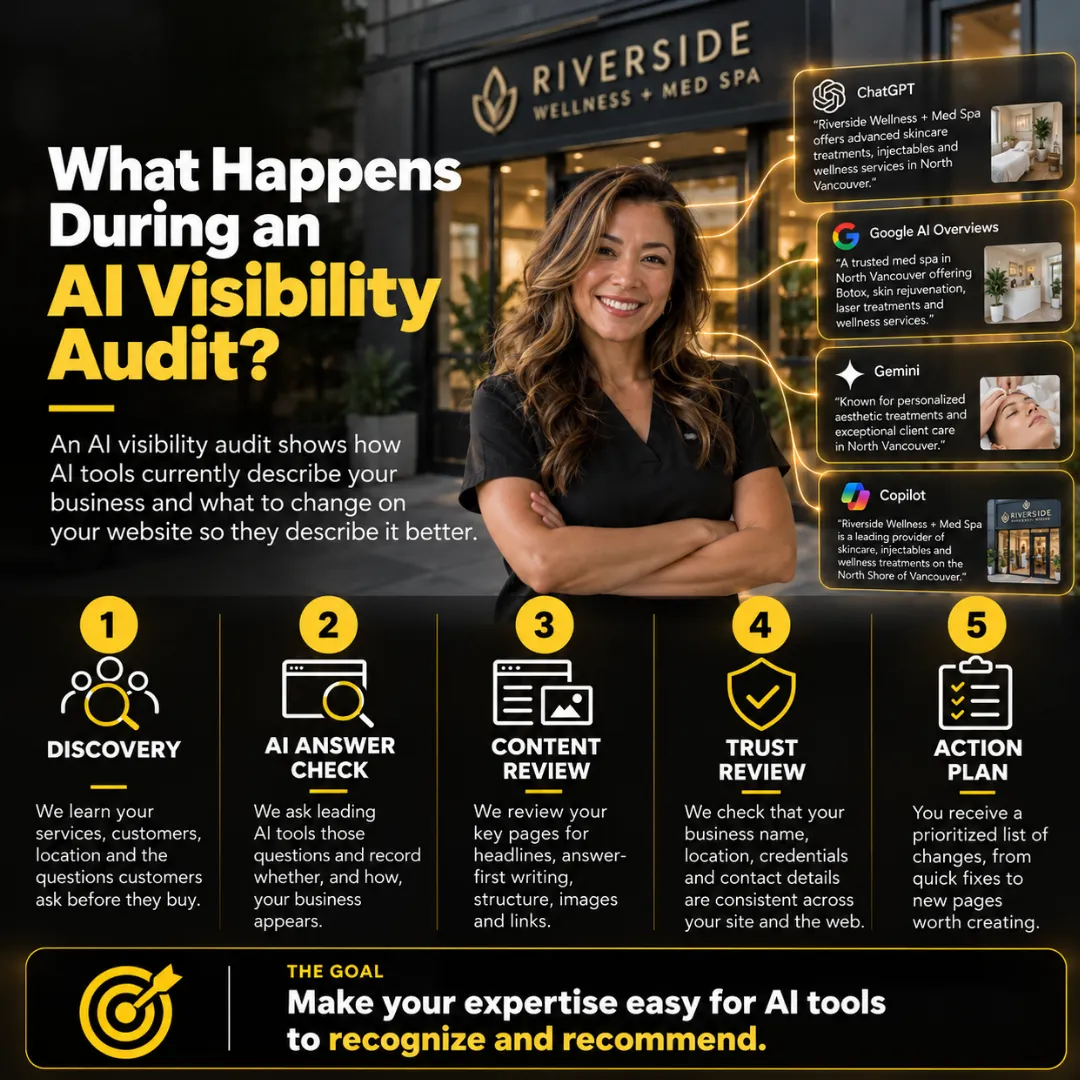
An AI Visibility Audit establishes a baseline for how AI Search currently understands and represents your business, and uncovers opportunities to improve that visibility.
1. Discovery
We dig into:
- Your services
- Your customers
- Your locations
- Your specializations
- Your expertise
- Your competitors
- Customer questions
- Buying intent
- Business differentiators
2. AI Answer Testing
We test real customer questions and look at:
- Whether your business appears
- How your business is described
- Which services are associated with it
- Whether the information is accurate
- Which competitors appear
- Which sources appear
- Where visibility gaps exist
3. Website and Content Review
We take a close look at:
- Service clarity
- Content depth
- Customer-question coverage
- Topic coverage
- Location information
- Page structure
- Internal linking
- Images and video
- Business information
- Content gaps
4. Trust and Authority Review
We look at how clearly your business is established beyond your own website, including relevant:
- Business listings
- Reviews
- Directories
- Associations
- Third-party mentions
- Credentials
- Local signals
- Authority sources
5. AI Search Opportunity Map
We identify the gaps between:
- What your business actually does
- What your website communicates
- What information exists elsewhere
- What AI currently appears to understand
- What competitors are visible for
- What customers are asking
6. Prioritized Action Plan
You get a roadmap covering:
- Immediate fixes
- Website changes
- Content opportunities
- Missing pages
- Authority opportunities
- Local visibility opportunities
- AI Search opportunities
- Longer-term priorities
The goal is simple: make your expertise easier for AI tools to recognize and recommend.
What AI Search Optimization Cannot Guarantee
No agency can guarantee that ChatGPT, Google AI Mode, Google AI Overviews, Gemini, Perplexity, or another AI system will recommend a particular business, and we’ll always be upfront about that.
Different systems use different technologies and sources. Results can vary by question, context, platform and user, and the AI platforms ultimately decide what shows up.
Google itself makes this limitation clear.
So instead, focus on what you can improve:
- Clarity
- Accuracy
- Expertise
- Content depth
- Topic coverage
- Customer-question coverage
- Location information
- Authority
- Consistency
- Accessibility
- Visual content
- Measurement
Frequently Asked Questions About AI Search
Why Isn’t My Business Showing Up in AI Search?
There isn’t one universal reason, and it’s rarely just one thing.
Potential gaps can include:
- Limited information about your services
- Weak coverage of the topics customers are asking about
- Unclear business information
- Unclear location information
- Limited supporting content
- Limited third-party information
- Technical discoverability issues
- Inconsistent information across the web
- Stronger or more relevant competing sources
An AI Visibility Audit can help pinpoint which gaps actually exist for your business, instead of guessing.
Does My Business Need Hundreds of Articles for AI Search?
No.
The goal should be useful topical depth, not sheer volume.
Your business may benefit from a mix of:
- Strong service pages
- Detailed guides
- Useful FAQs
- Original articles
- Expert commentary
- Case studies
- Comparison content
- Location information
- Images
- Video
What’s actually right for you depends on what your customers need to know, and what expertise your business genuinely has.
Does Google Use Multiple Searches to Create an AI Answer?
It can.
That’s one reason having real depth around your services and areas of expertise matters so much.
Are People Actually Asking Longer Questions in AI Search?
Yes.
Longer questions let customers pack in a lot more context about their problem, their preferences and what outcome they’re after.
Can AI Search Understand Images?
Yes.
Google describes AI Mode as multimodal, supporting searches using text, voice and images.
So it’s worth thinking about your visual content as part of your overall AI visibility strategy, not just as decoration on your website.
Can Businesses Measure Their Visibility in Google’s AI Search?
Yes.
That gives you a much better foundation for tracking your AI Search visibility over time.
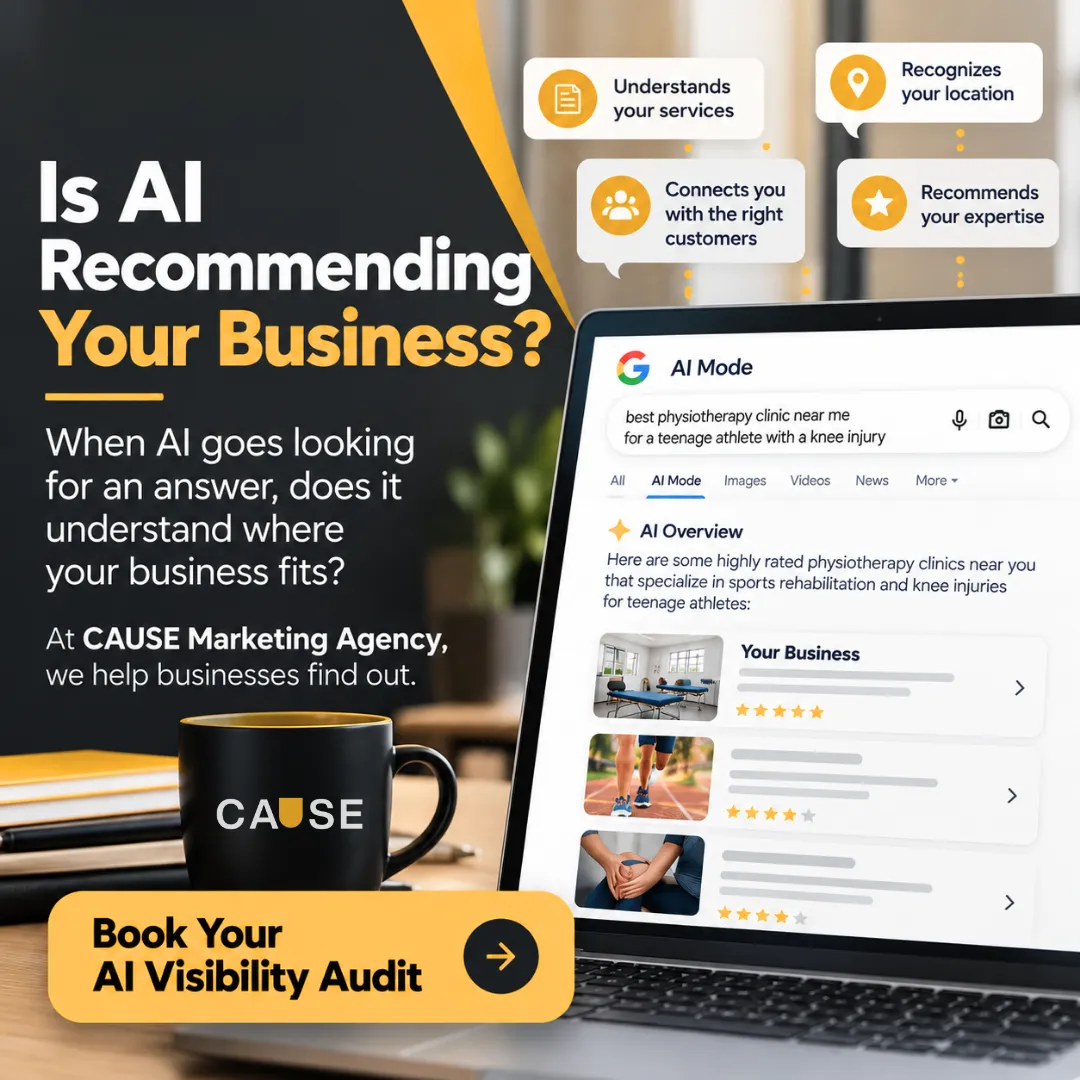
Is AI Recommending Your Business?
Your customers can now ask more detailed questions, research complicated needs, compare options and lean on AI to help them decide.
That raises a new question for every business:
When AI goes looking for an answer, does it understand where your business fits?
At CAUSE Marketing Agency, we help businesses find out. We’re a women-led agency founded by serial entrepreneur Leah Carter, and our AI Visibility Audit is built on the CAUSE Method™, our five-step process for auditing AI visibility, aligning your business information, upgrading your content, strengthening trust signals, and evolving your visibility as AI search keeps changing. We work with local businesses across Canada and the U.S., focused specifically on Answer Engine Optimization (AEO), helping platforms like Google AI, ChatGPT, Copilot, Gemini and Perplexity understand, trust and recommend them. Every client is paired with a dedicated AEO Specialist, a MarketingPRO® based in Canada or the U.S., who researches how your customers search, how AI interprets your industry, and how your competitors are positioned before building your plan.
“I’ve worked with a CAUSE MarketingPRO for nearly five years, and the impact on our marketing and brand has been undeniable. The consistency, strategic thinking, and execution have helped us grow, while saving us the cost and complexity of hiring an in-house team.” – Alex M., Founder & CEO
Our AI Visibility Audit looks at:
- How AI Search currently sees your business
- Whether your business is appearing for relevant questions
- How AI describes your business
- Which services AI associates with you
- Which competitors are appearing
- Where your content gaps are
- Where your authority gaps are
- What should be improved first
Then we turn those findings into an actionable plan for growing your AI Search visibility.
CAUSE Marketing Agency AI Search Agency | Canada
Book Your AI Visibility Audit
Find out whether your business is being found, understood and recommended by AI.
Research & Sources
This article draws on Google’s own published data and guidance about AI Search, including:
- Google’s May 2026 AI Mode usage report, covering user growth, query length, and search behaviour trends
- Google’s announcement introducing AI Mode in Canada, on multimodal and longer-query search behaviour
- Google’s Search Central documentation on AI features, explaining query fan-out and how AI Overviews and AI Mode source information
- Google’s May 2026 guidance for generative AI Search, on valuable, unique, non-commodity content
- Google’s June 2026 announcement of Search Generative AI performance reports, on measuring AI Overviews and AI Mode visibility in Search Console
- Google’s September 2026 announcement of Search Console reporting for multimodal search, covering Lens, Circle to Search, and image-based queries
CAUSE Marketing’s findings and recommendations are built on applying this guidance directly to real local business websites through our AI Visibility Audits.